

Vietnam’s economy remained strong in Q3, with GDP growth accelerating to 10.0%, driven by robust investment, record exports, and faster public investment disbursement.
Macroeconomics:
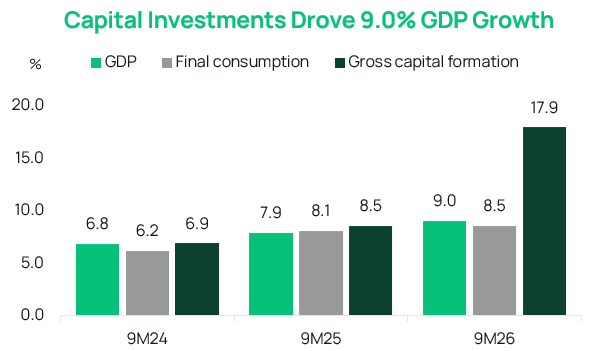
- GDP grew 9.95% YoY in Q3, up from 8.8% in Q2, lifting 9M growth to 9.0%; real investment rose 17.9%, with private investment now outpacing the state.
- Record September exports of $59.5bn (+39.1% YoY) delivered 2026’s first monthly trade surplus, $1.1bn, narrowing the YTD deficit to $19.4bn as earlier input imports turn into exports.
- Public investment disbursement reached 62.9% of plan by September, against 50.0% a year earlier.
Stock Market:
- The VN-Index fell 2.9% MoM in total return USD terms, trimming YTD returns to 2.0%, as rising term deposit costs outweighed near-10% GDP growth.
- FTSE inclusion on 21 September did not stop foreign investors from net selling a further $187mn on HOSE, two-thirds of it in VHM and VIC.
- Average daily matched turnover on HOSE fell to $508mn, the lowest of 2026, suggesting domestic investors are waiting for a clearer path on interest rates.
Chart of the Month
Monthly Insights: Vietnam’s investment-led growth accelerated to nearly 10% in Q3, while rate-driven market weakness has created an increasingly attractive valuation backdrop.
Vietnam grew close to 10% in Q3, and its stock market fell. The two are connected: the investment boom lifting output is also raising the price of the money that finances it, and in September equities priced the second effect. The VN-Index fell 2.9% in USD total-return terms, trimming YTD returns to 2.0%, or -0.9% in VND price terms. FTSE inclusion on 21 September did not stop foreign investors from net selling a further $187mn on HOSE, and average daily matched turnover of $508mn was the lowest of the year. The damage followed rate sensitivity. Brokers and developers suffered the most, while energy, lifted by oil, led the few gainers.
The pressure sits in term funding. The 1-month interbank rate averaged 6.1%, down from 6.9% in August, yet institutional 12-month deposit quotes kept climbing, to 7.4% in mid-September from 7.3% a month earlier and 2.4 percentage points above a year ago. Banks are competing for long-dated deposits because an infrastructure-led investment cycle needs long-dated loans. Real gross capital formation rose 17.9% in 9M26, double GDP growth, and private investment contributed 7.5 percentage points, overtaking the state’s 5.1 percentage points. That spending is now showing up in activity: industrial output rose 16.7% YoY in September, and exports reached a record $59.5bn, up 39.1%. Households have so far absorbed higher rates, with real retail sales growth edging up to 7.8% YTD.
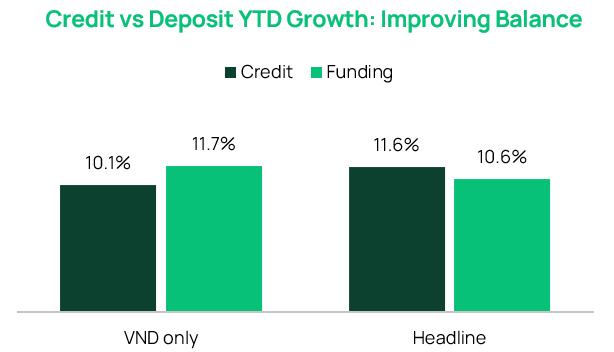
We expect the gap between growth and equity returns to narrow once term deposit rates peak. Early signs of a better funding balance are emerging. In VND, funding growth of 11.7% YTD has now overtaken credit at 10.1%. The improvement reflects softer VND loan demand at higher rates and savers responding to attractive deposit rates. Banks have also shifted to dollar lending, up 53%, and raised or planned $6.2bn of offshore loans and bonds.
We believe rates ease substantially only when significant real money enters the system, through SBV spot USD purchases, targeted refinancing or faster fiscal disbursement. The fiscal channel is moving: public investment reached 62.9% of plan, 12.9 percentage points ahead of last year, and a VND that has firmed 0.8% against the dollar YTD gives the SBV room to buy USD. Inflation limits how far it can go. Headline CPI of 5.1% is mostly oil, but core has risen to 4.5% from 3.2% in January, and the 9M average of 4.5% already sits at the bottom of the 4.5–5.0% ceiling, which favours targeted support over broad easing.
Valuations already reflect much of the interest rate pressure. The VN-Index trades at 13.5x trailing earnings, but five names that have carried it this year (VIC, VHM, VPL, STB and LPB) flatter both the multiple and the return. Excluding them, the index is down 9.4% YTD and trades at 11.4x, below the April 2025 tariff low and close to the 2020 and 2022 troughs. With growth close to 10% and the funding balance starting to improve, we see an attractive risk-reward at these levels, even if a re-rating waits for deposit rates to turn.
Read more about our previous monthly report Vietnam Market Insights – December 2025 here.